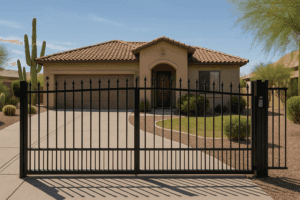
Protecting your home starts at the property line, and nothing says “keep out” quite like a sturdy barrier. Investing in high-quality driveway gates is the single most effective way to combine curb appeal with serious perimeter security. Let’s explore the best options for protecting your Maricopa County home.
When you think about home security, you probably picture cameras, motion sensors, or maybe a reinforced front door. But honestly? The battle for security is often won or lost before anyone even steps foot on your porch. A driveway gate serves as the first line of defense, a physical psychological deterrent that tells potential intruders, “This house is not an easy target.”
Living here in Maricopa County, we face unique challenges. We aren’t just battling bad actors; we are battling the elements. The blazing Arizona sun, the dust from the haboobs, and the intense monsoon rains all take a toll on outdoor structures.
So, how do you choose a gate that stands up to a crowbar and the desert heat? Let me explain.
Why Material Matters: Strength vs. Durability
You know what? Not all metal is created equal. When we talk about security, the material of the gate is the most critical factor. You need something heavy enough to withstand force but durable enough to last decades without crumbling into a pile of rust.
Here is a breakdown of the top contenders for security gates:
- Steel: This is the heavyweight champion. Steel is incredibly strong and difficult to cut or bend. If someone rams a steel gate, the gate usually wins. However, in our climate, steel must be galvanized and powder-coated to prevent rust.
- Wrought Iron: This offers a classic, upscale look and is very heavy. It provides excellent security due to its weight, but it requires more maintenance to keep the finish from deteriorating in the sun.
- Aluminum: Here’s the thing—aluminum is naturally rust-resistant, making it great for longevity. It is lighter than steel, which is easier on your gate opener, but it is also slightly more malleable. For pure high-security applications, steel usually edges out aluminum, but high-grade industrial aluminum is a very close second.
Material Comparison Guide
To help you visualize the trade-offs, here is a quick comparison of how these materials perform in the Phoenix metro area:
| Feature | Galvanized Steel | Wrought Iron | Industrial Aluminum |
|---|---|---|---|
| Impact Resistance | High | High | Moderate to High |
| Rust Resistance | Moderate (Needs Coating) | Low (Needs Maintenance) | Excellent |
| Weight | Heavy | Very Heavy | Lightweight |
| Security Level | Maximum | Maximum | High |
| Maintenance | Medium | High | Low |
Swing vs. Slide: The Mechanics of Security
Once you’ve picked your material, you have to decide how the gate moves. Believe it or not, the way your gate opens actually impacts its security level.
The Slide Gate (V-Track or Cantilever)
In the security world, slide gates are often preferred. Why? Because they are much harder to force open. A swing gate is held in place by the operator arm and hinges; if enough force is applied (like a vehicle pressing against it), the arm or brackets can snap.
A slide gate, however, is trapped within a guide system. Trying to push a slide gate open when it is in the locked position is nearly impossible without heavy machinery. Plus, if you have a steep driveway—common in certain parts of the Valley—a slide gate is often the only option that physically works.
The Swing Gate
Swing gates are beautiful and traditional. If you choose a swing gate for security, you must use a magnetic lock (maglock). A maglock engages when the gate closes, providing up to 1,200 pounds of holding force. Without a maglock, a swing gate can sometimes be pried open enough for a person to squeeze through.
Access Control: The Brains of the Operation
You can have the strongest steel gate in Arizona, but if the lock is flimsy, it doesn’t matter. Modern security isn’t just about bars; it’s about technology.
Gone are the days when you just had a clicker in your car visor. Honestly, that’s a security risk in itself—what if someone breaks into your car parked in the driveway? They now have the key to your property.
We recommend integrating the following for maximum security:
- Telephone Entry Systems: These connect directly to your cell phone. If someone presses the buzzer, you can see and speak to them from anywhere in the world.
- Keypads with Rolling Codes: Older keypads used fixed codes that could be intercepted. Modern systems use rolling codes that change every time, making them hack-proof.
- Free Exit Loops: These are buried underground and sense your car leaving, opening the gate automatically. This prevents you from having to stop and wait, reducing the time the gate sits open.
Privacy vs. Visibility: A Security Paradox
Here is a question we get all the time: “Should I get a solid gate so no one can see in, or an open gate so I can see out?”
It is a valid dilemma. Let’s break it down.
The Case for Privacy (Solid Gates):
If you have expensive cars, equipment, or just value your solitude, a solid gate (often steel frame with composite wood or metal backing) stops “crimes of opportunity.” If a thief can’t see what you have, they are less likely to target you.
The Case for Visibility (Picket Gates):
On the other hand, an open picket style allows you (and your neighbors) to see if someone is lurking by the entrance. Total privacy can sometimes provide cover for an intruder once they do get over the fence.
The Solution:
For most residential homes in Maricopa County, we suggest a hybrid approach or a picket gate with narrow spacing (spear-top pickets are a great physical deterrent). If you choose a solid gate, ensure you have security cameras installed on the exterior pillars to monitor the blind spots.
Anti-Lift and Anti-Climb Features
Professional intruders are smart. If they can’t cut the lock, they might try to lift the gate off its hinges.
At Arizona Fence & Gate, we prioritize details that average installers miss.
- Hinge placement: We weld hinges in alternating directions or use heavy-duty adjustable hinges that cannot be unbolted when the gate is closed.
- Anti-lift brackets: These are simple devices that prevent a slide gate from being leveraged up and off its tracks.
- Spear tops: As mentioned earlier, nothing discourages climbing like a row of sharp steel finials along the top rail.
The Arizona Factor: Dealing with HOA Regulations
You know how strict HOAs can be in the Valley. You might want a 10-foot razor-wire gate, but your HOA in Scottsdale or Gilbert is definitely not going to approve that.
We have extensive experience navigating HOA architectural guidelines. The best security gate is one that actually gets approved and installed. We know how to design gates that meet security needs—using thicker pickets, heavier gauges, and strategic heights—while still looking elegant enough to please the most demanding association board.
Maintenance is Security
Here’s the thing: a broken gate is an open door. In our dusty environment, debris can clog the tracks of a slide gate, and the intense heat can dry out the lubrication in your operator arms.
If your gate gets stuck halfway open because of a haboob, your security is compromised. We recommend a semi-annual maintenance check to grease the bearings, tighten the chains, and check the safety loops. A well-maintained gate is a secure gate.
Is It Time to Secure Your Perimeter?
Your home should be your safe haven. Whether you are looking to protect your family, secure your pets, or simply increase the value of your property, a custom driveway gate is an investment that pays off every single day.
Don’t wait until after a security scare to make a change. Let the experts at Arizona Fence & Gate design a solution that fits your lifestyle and the unique landscape of Maricopa County.
Ready to upgrade your home’s security? Call us today at 480-618-7925 or visit our website to Request a Free Quote.