Privacy is essential when you live in a bustling neighborhood. That is why sturdy block wall fences are the gold standard for backyards across Maricopa County. Let’s dive into how you can upgrade your security and peace of mind today.
Honestly, have you ever walked into your backyard to enjoy a morning coffee, only to make awkward eye contact with a neighbor? It’s an unsettling feeling. With housing developments in Phoenix, Mesa, and Chandler becoming denser, the proximity between homes is shrinking. Furthermore, the prevalence of two-story homes means that a standard 6-foot fence often doesn’t cut it anymore.
You know what? It’s not just about neighbors looking in. It’s about creating a sound buffer from traffic, securing your pets, and establishing a safe zone for your kids.
A privacy solution isn’t just a construction project; it’s an emotional investment in your sanctuary. When you upgrade your perimeter, you are reclaiming your outdoor living space. But why do we lean so heavily on Block Walls here in the desert? Let me explain.
If you are new to Arizona, you might wonder why we don’t see as many white picket fences or wood panels as they do in the Midwest. Here’s the thing: The Arizona environment is brutal on building materials.
Between the intense UV radiation, the extreme dry heat, and the sudden violence of monsoon storms, wood simply doesn’t stand a chance long-term. Termites are another major concern here. Concrete block walls, however, are built to endure.
Here is a quick look at how block compares to other materials in our specific climate:
| Feature | Block Wall | Wood Fence | Vinyl Fence |
|---|---|---|---|
| Durability | Excellent (50+ years) | Poor (5-10 years) | Moderate (10-20 years) |
| Wind Resistance | High (Withstands Monsoons) | Low (blows over easily) | Moderate (can crack) |
| Privacy | 100% Solid | Gaps develop over time | Solid panels available |
| Sound Barrier | High reduction | Minimal reduction | Low reduction |
| Termite Risk | None | High | None |
As you can see, for a long-term homeowner, the block wall is the only logical choice. It provides a solid thermal mass and a sound barrier that lighter materials just can’t match.
Perhaps you already have a block wall, but it is too short. This is a common complaint in older Maricopa County neighborhoods where walls were built to a standard 5 feet. If your neighbor builds a trampoline or adds a balcony, your privacy is gone.
So, do you have to tear it down and start over? Absolutely not.
We often utilize wall extensions. This involves removing the top cap of the existing wall, drilling into the existing grout, inserting new rebar for structural integrity, and laying new courses of block on top.
Here are a few popular ways to add height:
- Standard Block Extension: We simply match the existing block size and add rows to reach your desired height.
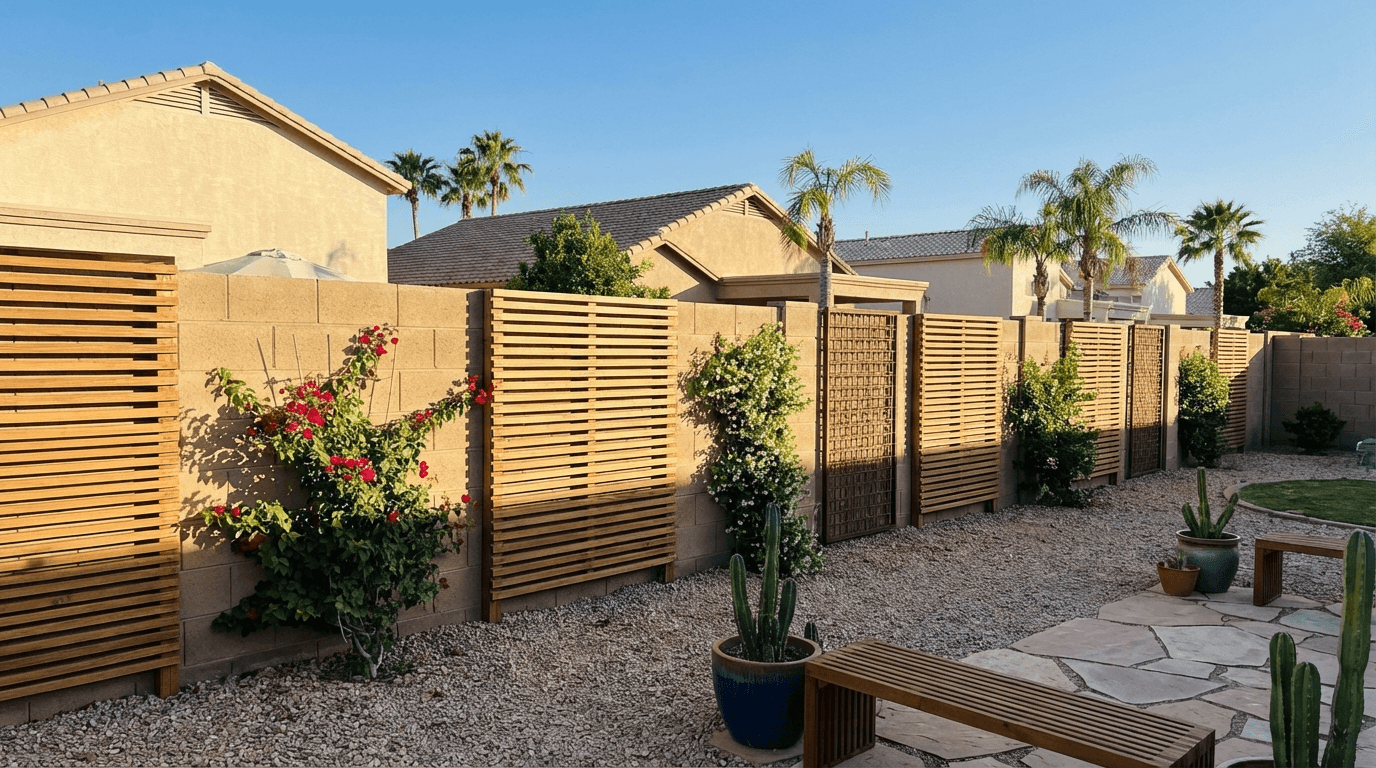
- Privacy Screen Toppers: These are decorative metal or composite panels bolted to the top of the wall. They allow airflow (crucial for wind resistance) while obscuring the view.
- Open Cell Block: Utilizing decorative breeze blocks on the top rows adds a mid-century modern flair while increasing height without making the yard feel like a prison cell.
Functionality is key, but let’s be honest—nobody wants their backyard to look like a fortress or a prison yard. Standard grey masonry is functional, but it isn’t exactly “warm.”
You know what makes a huge difference? Surface treatments. A block wall is essentially a blank canvas. At Arizona Fence & Gate, we’ve seen homeowners completely transform their outdoor aesthetic just by dressing up the masonry.
Consider these finishes:
- Stucco: This is the most popular choice in Arizona. It matches the exterior of most homes and provides a clean, seamless look that can be painted any color.
- Stone Veneer: Adding stacked stone to columns or the entire wall adds a luxurious, high-end feel. It adds texture and breaks up the monotony of a long wall.
- Paint: Even a simple coat of high-quality masonry paint can seal the block against moisture and brighten up the yard.
- Lighting: Integrating low-voltage lighting into the wall or caps creates ambiance at night and adds a layer of security.
A wall is only as secure as its weakest point, and typically, that is the gate. If you have a solid 6-foot block wall but a flimsy, see-through gate, your privacy solution is incomplete.
The integration of the gate into the block columns requires expertise. The heavy steel frames need to be anchored deeply into the masonry to prevent sagging over time.
For maximum privacy, we recommend:
- RV Gates with Composite Slats: These offer the strength of steel frames with the visual barrier of composite wood, which won’t rot or warp in the sun.
- Solid Sheet Metal Backing: For wrought Iron Gates, adding a perforated or solid metal backing plate ensures air can pass through (reducing wind load) while stopping prying eyes.
- Automatic Openers: Nothing says “secure” like not having to get out of your car to open the side yard for parking.
Here’s the thing that trips up many homeowners: Regulations.
In Maricopa County, almost every city—be it Scottsdale, Gilbert, or Glendale—has strict zoning codes regarding fence height. Generally, backyard fences can go up to 6 feet without a permit, but going higher (often up to 8 feet) usually requires engineering and city approval.
Furthermore, if you live in an HOA, you likely have CC&Rs (Covenants, Conditions, and Restrictions) that dictate the color, texture, and height of your party walls.
Before breaking ground, we always advise:
- Checking your property lines (a survey is cheaper than a lawsuit!).
- Reviewing your HOA guidelines specifically regarding “party walls” (walls shared with neighbors).
- Understanding the setback rules for front yard walls versus backyard walls.
Arizona Fence & Gate has extensive experience dealing with these local nuances. We help ensure your project doesn’t just look good but is also legally compliant.
While block walls are incredibly low maintenance compared to wood, they aren’t entirely “magic.” To keep your privacy wall standing for decades, you need to keep an eye on a few things.
Water is the enemy. Yes, even in the desert. If your irrigation system is constantly spraying the base of your wall, or if the drainage in your yard pools water against the footing, you will eventually see efflorescence. This is that white, chalky powder that forms on the block. It’s salt migrating out of the masonry.
Over time, constant moisture can erode the footing and cause the wall to lean.
Vegetation warnings:
- Avoid planting aggressive tree species (like Ficus or Sissoo) within 5 feet of the wall. Their roots will lift the foundation.
- Keep vines in check. While creeping fig looks beautiful, it digs into the mortar and can compromise the structural integrity over time if not trimmed.
Let’s talk numbers for a second. Is a block wall cheaper than wood fencing? Usually, no. The upfront cost is higher due to the materials (concrete, rebar, mortar) and the labor (digging deep footings, laying block by hand).
However, you have to look at the lifetime value. A wood fence might cost half as much today, but you will likely replace it three or four times over the lifespan of a single block wall. When you factor in the lack of maintenance, the increased property value, and the superior privacy, the block wall pays for itself.
Plus, there is the intangible value of silence. The acoustic dampening properties of a solid masonry wall can significantly reduce the noise from nearby streets or loud neighbors, making your backyard a true retreat.
Your home is your castle, and it deserves a perimeter that reflects that. Whether you need a brand new installation for a new build or an extension to an existing wall for better privacy, quality craftsmanship matters. You don’t want a wall that cracks, leans, or fails when the monsoon winds pick up.
At Arizona Fence & Gate, we understand the specific soil conditions and climate challenges of Maricopa County. We build walls that stand the test of time and look great doing it.
Are you ready to reclaim your privacy? Call us today at 480-618-7925 or visit our website to Request a Free Quote. Let’s build something solid together.